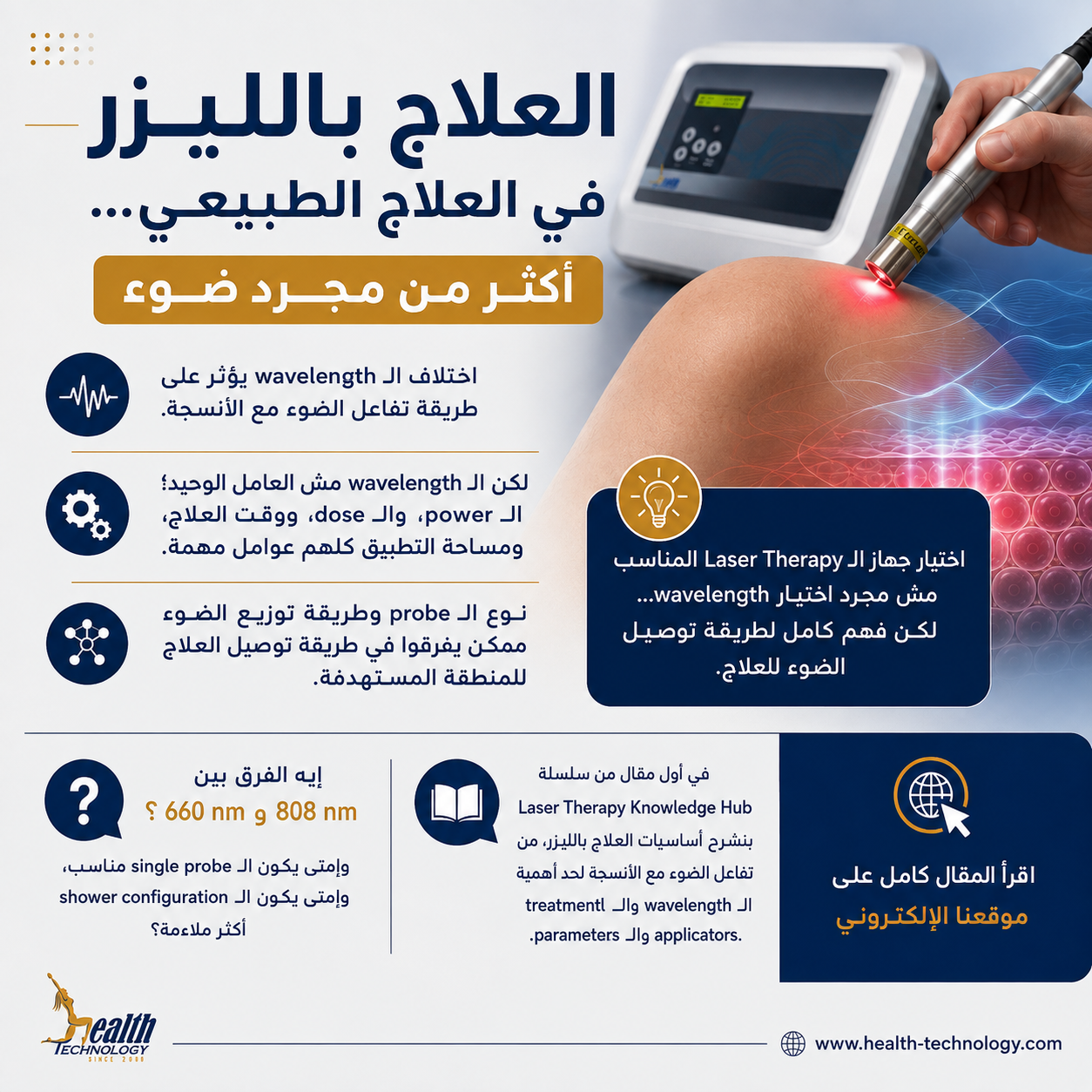
Laser therapy has become an increasingly recognized tool in physiotherapy and rehabilitation. But despite the growing use of therapeutic laser devices, many questions remain: What exactly does laser therapy do? How does light interact with tissue? Why are different wavelengths used? And why do treatment parameters and applicator design matter?
To answer these questions, it is useful to understand the science behind photobiomodulation (PBM)—the process through which specific wavelengths of non-ionizing light can influence biological activity in cells and tissues.
This article introduces the fundamentals of therapeutic laser and explains how it fits into modern physiotherapy practice.
What Is Therapeutic Laser?
Therapeutic laser is a form of light-based therapy in which controlled amounts of laser light are applied to biological tissue.
It is commonly associated with terms such as low-level laser therapy (LLLT), low-level light therapy, and photobiomodulation. Today, photobiomodulation is widely used as the broader scientific term because the biological response is not limited to lasers; other light sources, such as LEDs, can also produce photobiomodulatory effects.
Unlike surgical lasers designed to cut, ablate, or thermally alter tissue, therapeutic laser applications generally aim to deliver light at levels that produce biological responses without significant tissue heating or structural damage.
In physiotherapy, therapeutic laser may be incorporated into rehabilitation protocols alongside other interventions, depending on the patient’s condition, treatment objectives, and clinical assessment.
Understanding Photobiomodulation
At the heart of therapeutic laser is a relatively simple concept:
Light can influence biological processes.
When appropriate wavelengths of light reach tissue, photons can be absorbed by molecules known as chromophores. These light-sensitive molecules can initiate cellular and biochemical changes.
One of the best-studied targets is cytochrome c oxidase, an enzyme associated with the mitochondrial electron transport chain. Research suggests that photobiomodulation can influence mitochondrial activity and downstream signaling processes, including changes involving ATP, reactive oxygen species, nitric oxide, and intracellular calcium.
The important point is that therapeutic laser is not simply about “shining light” on an area.
The biological response depends on how the light is delivered.
How Does Laser Light Interact With Biological Tissue?
When laser light reaches tissue, several things can happen.
Some of the light may be reflected from the surface. Some may be scattered as it travels through the tissue. Some may be absorbed by chromophores within the tissue.
The absorbed photons can then contribute to biological signaling.
This is one reason why wavelength is such an important consideration in photobiomodulation.
Different wavelengths interact differently with tissue because tissue contains different light-absorbing molecules and because the optical properties of tissue vary according to wavelength.
genui{“physics_waves_optics_oscillations_earth_learning_block”:{“type_id”:“WAVE_SPEED”,“locale_override”:“en-US”}}
In practical terms, this means that the wavelength selected for therapeutic application is not simply a specification printed on a device. It is one of the factors that influences how light energy is delivered to the target tissue.
Why Does Wavelength Matter?
One of the most important characteristics of a therapeutic laser is its wavelength, measured in nanometers (nm).
Therapeutic photobiomodulation commonly uses wavelengths in the red and near-infrared portions of the spectrum.
Health Technology’s Laser Pro family uses two principal wavelengths:
- 660 nm
- 808 nm
These wavelengths do not represent interchangeable numbers. Their interaction with tissue can differ, and wavelength is one of the factors that influences light penetration and absorption.
However, it is important not to oversimplify this relationship by saying that one wavelength is automatically “better” or that wavelength alone determines treatment depth or effectiveness.
The clinical response depends on multiple variables, including the wavelength, irradiance, delivered energy, treatment duration, treatment area, and application method.
This is why understanding laser therapy requires looking at the complete treatment parameters, rather than focusing on wavelength alone.
Why Do Treatment Parameters Matter?
Two laser devices can use the same wavelength and still deliver very different treatments.
Important parameters can include:
- Wavelength
- Output power
- Irradiance (power density)
- Energy / fluence
- Treatment duration
- Treatment area
- Continuous or pulsed operation
- Application technique
Research on photobiomodulation has shown substantial variation in the parameters and protocols used across studies. Differences in wavelength, power, energy density, treatment duration, and other variables can contribute to differences in biological and clinical responses.
This is particularly important because photobiomodulation does not necessarily follow a simple “more is better” relationship. The biological response can vary with dose, and inappropriate parameters may reduce or change the expected response.
For clinicians, this reinforces an important principle:
The effectiveness of therapeutic laser depends not only on the device, but on how the treatment is configured and applied.
Why Are Different Laser Applicators Used?
The treatment area is another important consideration.
A single probe allows the practitioner to apply laser energy to a specific point or relatively localized area. This can be useful when treatment requires focused application.
A multi-diode or shower applicator, on the other hand, can distribute light over a broader treatment area or multiple points simultaneously, depending on its design and intended use.
This difference is not simply about convenience. The geometry of the applicator affects how energy is distributed over the treatment area and therefore needs to be considered together with power, treatment time, dose, and other parameters.
This is why therapeutic laser systems may offer different applicator configurations rather than relying on one universal probe.
Where Does Laser Therapy Fit Into Physiotherapy?
Therapeutic laser is best understood as one tool within a broader physiotherapy and rehabilitation approach.
Depending on the clinical situation and the applicable treatment protocol, photobiomodulation has been investigated and used in areas including pain management, tissue repair, inflammation-related processes, and rehabilitation of musculoskeletal conditions.
It should not be viewed as a replacement for clinical assessment or for every other component of rehabilitation.
Instead, the physiotherapist determines whether laser therapy is appropriate and how it should be integrated with the overall treatment plan.
This is also why clinical knowledge matters as much as the equipment itself. Understanding the patient’s condition, treatment objective, target area, and appropriate parameters is essential when selecting and applying a therapeutic laser protocol.
The Laser Pro Family by Health Technology
Health Technology’s Laser Pro family has been designed around different wavelength and applicator configurations to provide flexibility in therapeutic laser applications.
The family currently includes four configurations:
Laser Pro 660
- 1 × 660 nm probe
Laser Pro 808
- 1 × 808 nm probe
Laser Pro 660 + Shower
- 1 × 660 nm probe
- 1 × 5-diode 660 nm shower
Laser Pro 808 + Shower
- 1 × 808 nm probe
- 1 × 5-diode 660 nm shower
The different configurations allow practitioners to consider both wavelength and application method when selecting a system for their clinical environment.
In our next articles, we will look more closely at these two important aspects of therapeutic laser—starting with one of the most common questions:
660 nm vs. 808 nm: What Is the Difference in Laser Therapy?
Key Takeaways
- Therapeutic laser is a form of light-based therapy associated with photobiomodulation.
- Photobiomodulation uses non-ionizing light to influence biological processes within cells and tissues.
- Wavelength affects how light interacts with biological tissue and is an important consideration in treatment design.
- Wavelength alone does not determine treatment effectiveness; power, dose, duration, treatment area, and application method also matter.
- Different applicators can provide different ways of delivering light to a treatment area.
- Laser therapy can be incorporated into physiotherapy and rehabilitation as part of an appropriate clinical treatment approach.
- Understanding the science behind the light helps clinicians make more informed decisions about therapeutic laser technology.
Explore the Laser Pro family and discover the configuration that fits your clinical needs at the link below:
https://www.health-technology.net/category/physiotherapy/laser-physiotherapy/