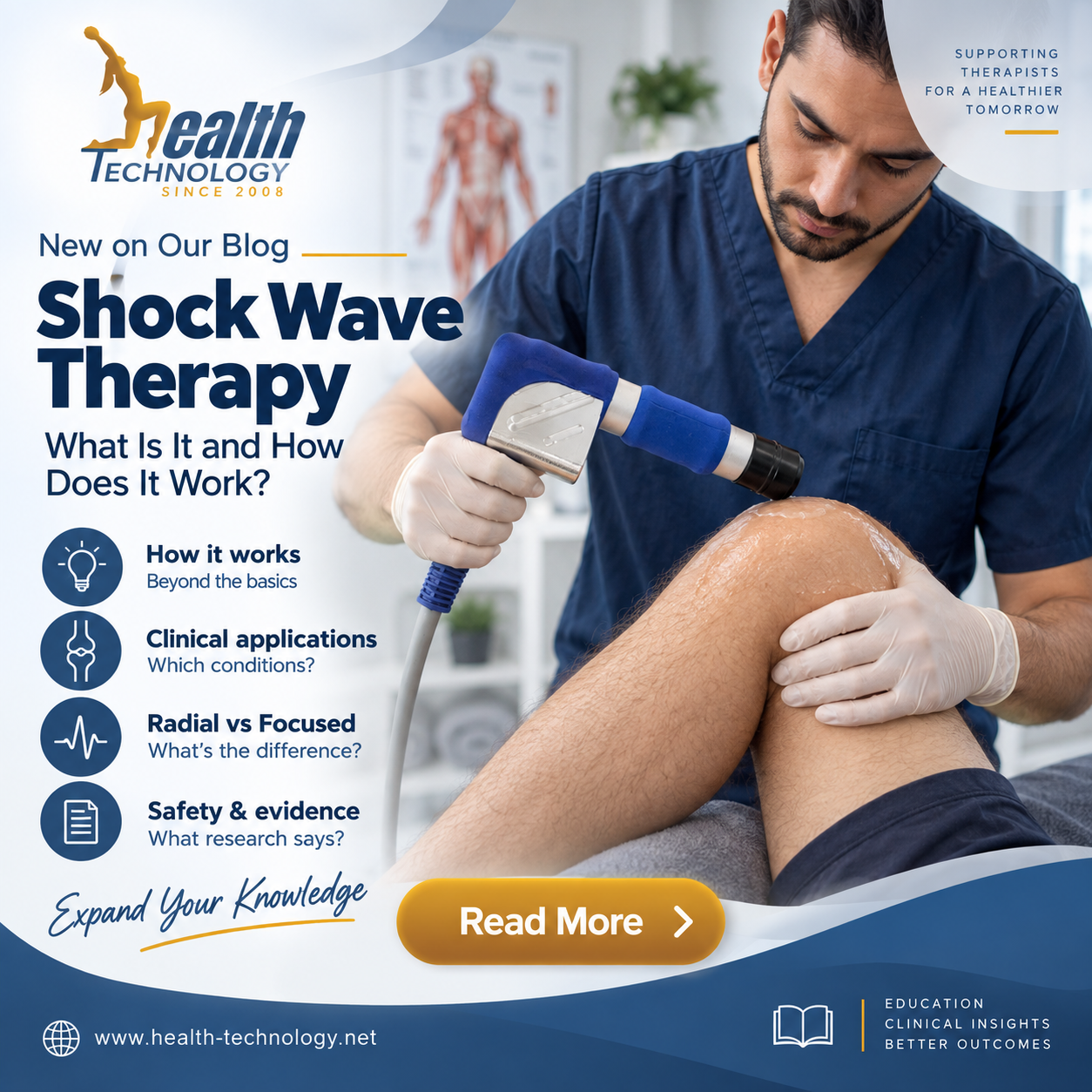
Musculoskeletal disorders such as tendinopathies, plantar fasciitis and other persistent soft-tissue conditions are among the common challenges encountered in physiotherapy practice. When symptoms persist despite conventional conservative management, clinicians may consider additional treatment modalities as part of a broader rehabilitation program.
Shock Wave Therapy has become one of the technologies used in modern musculoskeletal rehabilitation. It is a non-invasive treatment that delivers mechanical acoustic energy to a targeted area of the body.
But what exactly is Shock Wave Therapy? How does it work, and where does it fit within physiotherapy practice?
This article provides an introduction to the technology, its mechanisms, major types and clinical applications.
What Is Shock Wave Therapy?
Shock Wave Therapy is a non-invasive therapeutic technique in which externally generated mechanical pressure waves are transmitted into body tissues.
In clinical literature, the term Extracorporeal Shock Wave Therapy (ESWT) is commonly used. “Extracorporeal” simply means that the energy is generated outside the body and then delivered to the treatment area.
Shock wave technology was initially associated with medical applications such as lithotripsy for breaking kidney stones. Its therapeutic applications subsequently expanded, and different forms of shock wave technology are now used in musculoskeletal medicine and rehabilitation.
Today, ESWT is used clinically for several musculoskeletal conditions, particularly some chronic tendinopathies. The International Society for Medical Shockwave Treatment (ISMST), for example, lists conditions including calcific shoulder tendinopathy, lateral epicondylopathy, patellar tendinopathy, Achilles tendinopathy and plantar fasciitis among established indications for shock wave treatment.
How Does Shock Wave Therapy Work?
Unlike electrical stimulation, Shock Wave Therapy delivers mechanical energy rather than electrical current into the treatment area.
The treatment device generates pressure waves that travel through the applicator and into the targeted tissues.
The biological response to these mechanical forces is complex and remains an active area of research. Proposed and observed effects include mechanical stimulation of tissue, changes in cellular signaling and processes associated with tissue remodeling.
This interaction between mechanical forces and biological responses is often discussed under the concept of mechanotransduction — the process through which cells respond to mechanical stimuli by initiating biological activity.
Importantly, Shock Wave Therapy should not simply be described as “breaking scar tissue” or “increasing blood circulation.” Such explanations are common in marketing material but oversimplify a much more complex biological process.
What Happens During a Shock Wave Therapy Session?
Before treatment, the clinician identifies the appropriate treatment area based on clinical assessment and diagnosis.
A coupling medium, typically ultrasound gel, is placed between the applicator and the patient’s skin. This helps transfer the mechanical energy efficiently from the applicator into the tissues.
The therapist then positions the applicator over the selected area and delivers a predetermined number of impulses.
Depending on the technology and clinical protocol, several treatment parameters may be adjusted, including:
- Pressure or energy level
- Frequency
- Number of impulses
- Applicator or transmitter selection
- Treatment location and depth
These parameters should not be considered interchangeable. Appropriate settings depend on the technology being used, the targeted tissue, the clinical condition and the individual patient.
There is therefore no single universal Shock Wave Therapy protocol suitable for every musculoskeletal condition.
Radial and Focused Shock Wave Therapy
One of the most important distinctions in Shock Wave Therapy is between radial pressure wave therapy and focused shock wave therapy.
Although both technologies are frequently grouped under the general term “shock wave,” their physical characteristics and energy distribution are different.
Radial Shock Wave Therapy
In radial systems, a projectile is accelerated inside the handpiece and strikes an applicator or transmitter. The resulting mechanical pressure wave spreads outward into the tissue.
The energy is highest near the applicator and decreases with increasing tissue depth.
Radial technology is therefore commonly associated with the treatment of relatively superficial musculoskeletal structures.
Focused Shock Wave Therapy
Focused systems generate shock waves that can concentrate energy at a selected point within the tissue.
Depending on the system, focused shock waves may be generated using electrohydraulic, electromagnetic or piezoelectric technology.
Their ability to deliver energy at greater and more precisely defined depths makes focused systems suitable for applications that differ from those typically addressed using radial systems.
The choice between radial and focused technology should therefore depend on the intended clinical application rather than assuming that one technology is universally superior to the other.
Where Is Shock Wave Therapy Used in Physiotherapy?
Shock Wave Therapy has been investigated across a wide range of musculoskeletal conditions, but the strength of scientific evidence is not identical for every indication.
Among the conditions commonly associated with ESWT are:
Plantar fasciitis
Shock Wave Therapy has been used particularly in persistent or refractory plantar heel pain.
Achilles tendinopathy
ESWT may be incorporated into rehabilitation programs for selected patients with persistent Achilles tendon problems.
Patellar tendinopathy
Shock Wave Therapy has also been investigated in chronic patellar tendon disorders, particularly in physically active populations.
Lateral epicondylopathy
Often known as tennis elbow, lateral elbow tendinopathy is another established application of Shock Wave Therapy.
Calcific shoulder tendinopathy
Focused shock wave technology in particular has been studied for calcific deposits affecting the rotator cuff.
Greater trochanteric pain syndrome
Research has also investigated ESWT for selected tendinopathies involving the lateral hip.
The International Society for Medical Shockwave Treatment recognizes several of these chronic tendinopathies as standard indications for ESWT.
However, evidence varies according to the condition, treatment protocol and type of shock wave technology. A 2024 systematic review and meta-analysis, for example, found more favorable evidence for lower-limb and calcific tendinopathies than for some upper-limb and non-calcific tendinopathies.
This distinction is important: Shock Wave Therapy should not be presented as an equally effective treatment for every musculoskeletal condition.
Is Shock Wave Therapy a Stand-Alone Treatment?
Not necessarily.
In physiotherapy, Shock Wave Therapy can be considered a therapeutic modality within a broader clinical management strategy, rather than a replacement for clinical assessment, therapeutic exercise or rehabilitation.
Depending on the patient’s condition, treatment may be integrated with approaches such as:
- Therapeutic exercise
- Progressive loading programs
- Mobility exercises
- Patient education
- Activity modification
- Other appropriate physiotherapy interventions
The treatment plan should therefore begin with the patient’s diagnosis and rehabilitation goals rather than simply with the availability of a particular device.
What Does Scientific Evidence Say About Shock Wave Therapy?
Scientific research into ESWT has grown substantially, particularly in relation to chronic tendinopathies.
Systematic reviews and randomized trials have reported improvements in pain and function for certain conditions, particularly some lower-limb and calcific tendinopathies.
However, the overall research literature is not uniform.
Different studies use different devices, energy levels, treatment frequencies, numbers of sessions and patient-selection criteria. Reviews have also identified methodological limitations within parts of the published evidence.
For example, NICE guidance on ESWT for refractory plantar fasciitis states that there are no major safety concerns but describes the evidence regarding efficacy as inconsistent.
Therefore, responsible interpretation of the evidence requires looking at the specific condition and treatment protocol, rather than making broad claims that Shock Wave Therapy is effective for every patient or every musculoskeletal disorder.
Is Shock Wave Therapy Safe?
Shock Wave Therapy is generally considered a non-invasive procedure, but that does not mean it is appropriate for every patient.
Temporary discomfort, localized tenderness, redness or minor bruising may occur following treatment.
There are also situations in which Shock Wave Therapy should not be applied, or where additional clinical precautions are required.
According to ISMST guidance, contraindications vary according to the type and energy of shock wave treatment and include situations such as a malignant tumor or fetus within the treatment field. Additional restrictions apply to high-energy focused shock waves.
Proper patient assessment and knowledge of the technology are therefore essential before treatment.
We will examine contraindications, precautions and safety considerations in detail in a dedicated article in this series.
Why Device Parameters Matter
A Shock Wave Therapy device should not be evaluated simply by asking whether it “produces shock waves.”
Several technical factors influence how the system can be used clinically.
These include:
Pressure or energy – determines the intensity of the delivered mechanical energy.
Frequency – determines how rapidly impulses are delivered.
Applicator design – affects the way energy is transferred to the targeted area.
Number of impulses – forms part of the treatment dose.
Consistency of output – reliable energy delivery is important for repeatable clinical treatment.
For a professional clinic, device evaluation should also extend beyond treatment specifications.
Reliability, technical support, spare-parts availability, maintenance requirements, training and long-term operating costs can all affect the practical value of the equipment.
These factors become especially important when the device is used regularly in a busy physiotherapy clinic.
Shock Wave Therapy Is a Technology — Clinical Judgment Remains Essential
Modern physiotherapy increasingly incorporates sophisticated technologies, but technology itself does not determine the clinical outcome.
Successful application of Shock Wave Therapy begins with proper patient assessment, appropriate diagnosis, suitable patient selection and selection of treatment parameters based on the clinical situation.
The therapist must also determine how Shock Wave Therapy fits within the patient’s wider rehabilitation program.
For this reason, professional equipment should support — rather than replace — the knowledge and clinical judgment of the healthcare professional.
The Bottom Line
Shock Wave Therapy is a non-invasive technology that delivers mechanical pressure waves into targeted tissues and is used in the management of selected musculoskeletal conditions.
Its applications include several chronic tendinopathies and other musculoskeletal disorders, but clinical evidence varies between conditions and treatment protocols.
Understanding the technology is therefore the first step toward using it appropriately.
For physiotherapists and clinic owners, the important questions go beyond simply asking, “Does this clinic have a shock wave device?”
They include:
Which type of shock wave technology is being used? What parameters can it deliver? What clinical application is intended? And how reliably can the device provide the required treatment over years of clinical use?
These questions will be explored throughout Health Technology’s Shock Wave Therapy educational series.
Next Article
Radial vs Focused Shock Wave Therapy: What’s the Difference?
The next article will examine how radial and focused technologies generate and deliver mechanical energy, their differences in penetration and energy distribution, and why understanding those differences matters when selecting a Shock Wave Therapy system.
References
- International Society for Medical Shockwave Treatment (ISMST). Consensus Statement on ESWT Indications and Contraindications and current ISMST recommendations.
- Elgendy MH, Khalil SE, ElMeligie MM, Elazab DR. Effectiveness of extracorporeal shockwave therapy in treatment of upper and lower limb tendinopathies: A systematic review and meta-analysis. Physiotherapy Research International. 2024;29(1).
- National Institute for Health and Care Excellence (NICE). Extracorporeal shockwave therapy for refractory plantar fasciitis. HealthTech Guidance 200.
- International Society for Medical Shockwave Treatment (ISMST). Guidelines for Extracorporeal Shock Wave Therapy.
Professional-use notice: This article is intended for educational purposes and healthcare professionals. It does not replace clinical assessment, professional training, device-specific instructions for use, or applicable regulatory requirements.